Tuesday, May 26, 2026
New Metric Shows Housing Market Mismatch: More Homes Are for Sale, but Not at Prices Buyers Can Afford
New Metric Shows Housing Market Mismatch: More Homes Are for Sale, but Not at Prices Buyers Can Afford: New Listing-Income Alignment Score reveals households can access one-quarter fewer homes than in a balanced market.

Monday, May 18, 2026
NAR Existing-Home Sales Report Shows 0.2% Increase in April
NAR Existing-Home Sales Report Shows 0.2% Increase in April: Month-over-month sales increased in the Midwest and the South, were unchanged in the Northeast, and declined in the West. On a year-over-year basis, sales rose in the South, were flat in the West, and fell in both the Northeast and Midwest.
Monday, May 11, 2026
Could Co-Buying Be the Answer for Some First-Time Buyers?
Could Co-Buying Be the Answer for Some First-Time Buyers?

For a lot of would-be first-time buyers, affordability is the thing that’s standing in the way. But some buyers are getting creative and finding a way to still make the numbers work – and that’s through co-buying.
The Dream Is Still Alive. The Math Just Isn’t Working for Everyone.
Young people haven’t given up on the dream of owning a home – not even close. According to FirstHome IQ, homeownership still ranks among the top life goals for the next generation.
The problem? 73% of Gen Z and millennial buyers cite affordability as the reason for not making homeownership a priority. And it shows. First-time buyers now make up just 21% of all home purchases, the lowest share since the National Association of Realtors (NAR) started tracking the data in 1981.
But still, some buyers are making it happen. And a portion of them are turning to co-buying to get their foot in the door.
So, What’s Co-Buying?
Co-buying means purchasing a home with someone else, like a friend, sibling, or unmarried partner. You combine incomes, split the down payment, and share monthly costs. For some people, it’s a creative way to turn “someday” into a concrete move-in date that’s just around the corner.
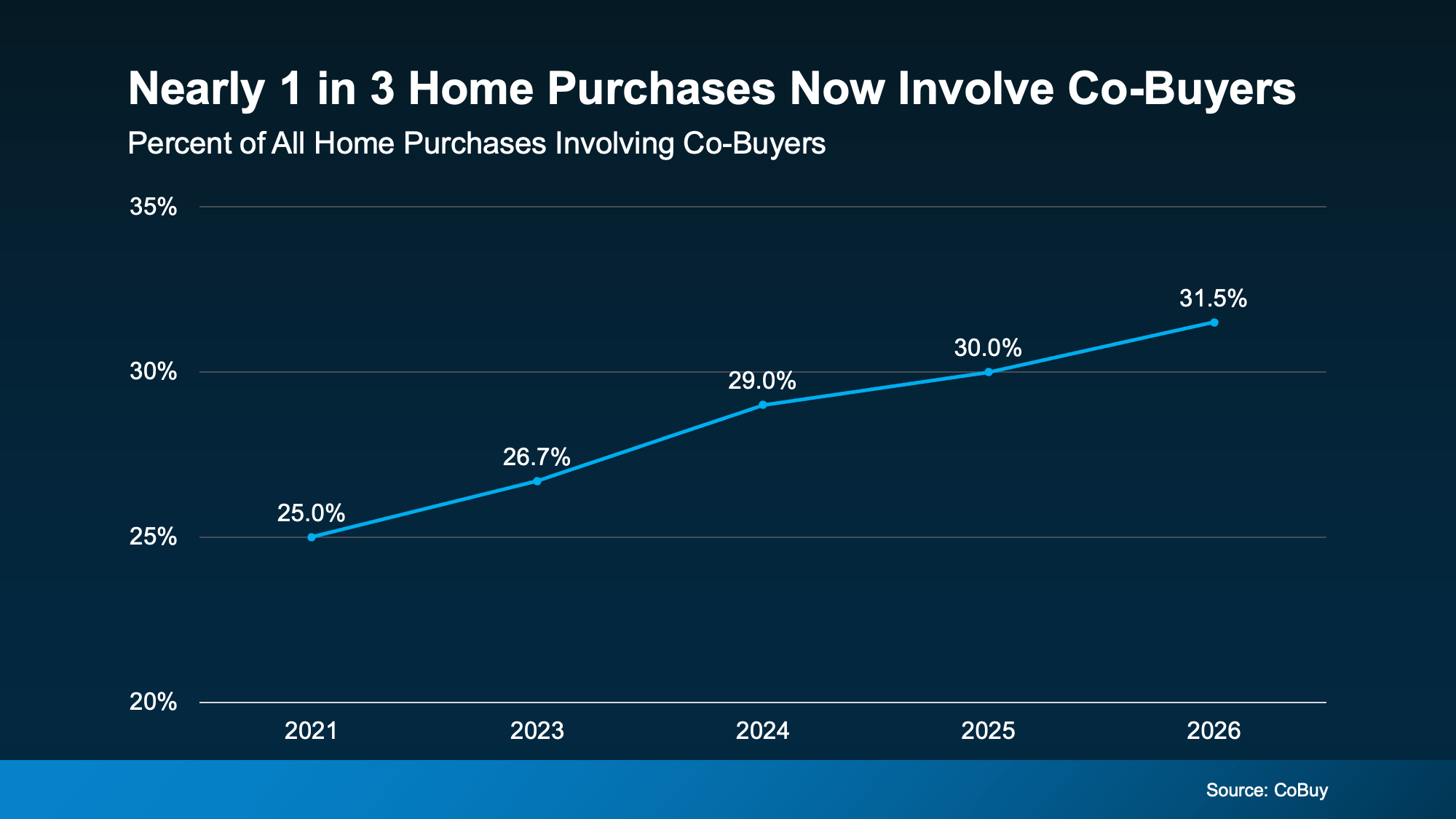
And it's catching on fast, just look at where things stand today. According to CoBuy.io, 64 million Americans now co-own a home with someone they’re not married to. In fact, 31.5% of home purchases involve co-buyers (see graph below):
 Why It Works
Here are just a few of the top reasons buyers are going this route, according to NerdWallet:
Quicker path to homeownership: If owning a home is a serious goal for you, buying with someone else can help make that reality on a shorter timeline. Two or more people can save up a down payment a lot faster than one. That’s less time waiting and more time building equity in a place that’s yours.
More purchasing power: With multiple incomes going toward the home purchase, you might be able to afford a nicer home or live in a more popular neighborhood. Sometimes teaming up means getting the home you actually want, not just the one you can barely afford on your own.
Easier loan qualification: Added income from more than one buyer can also help with your debt-to-income (DTI) ratio, which the lender will calculate based on all the borrowers.
Lower housing costs: Splitting up a mortgage payment multiple ways could maybe even make owning less expensive than renting. Plus, sharing costs can make repairs or renovations more manageable, too.
Things To Keep in Mind
If you’re considering going this route, there are some things you’ll want to think over. For starters, co-buying works best with people you trust and share financial goals with. So, before moving forward, make sure everyone agrees on how costs are split, who handles what, and what happens if one person wants to sell down the road.
That’s why a written co-ownership agreement can be a smart move. It keeps everyone on the same page and helps avoid headaches down the line. Think of it less like a legal formality and more like a game plan for your new investment.
Bottom Line
Affordability challenges are real, but they don't have to mean waiting indefinitely. Co-buying is helping some first-time buyers stop waiting and start putting down roots.
If you're curious whether it could work for your situation, let's talk. Reach out today and let's figure out your path to homeownership together.
Wednesday, May 6, 2026
4 Ways To Give Your Offer an Edge This Spring
4 Ways To Give Your Offer an Edge This Spring

Looking to buy a home this season? Here's what you should know.
Buyers have more leverage today than they’ve had in years. There are more homes to choose from and, in many areas, sellers are more open to negotiation.
But that doesn’t mean competition is gone completely. These days, it varies a lot depending on where you’re hoping to move.
If you’re buying in a popular neighborhood, or in a market where there aren’t many homes for sale, you may still find yourself competing with another buyer.
And that’s especially true in the Spring. Here's how to stay one step ahead of any competition this season.
Why Your Best Offer Still Matters This Spring
According to experts at Zillow and Realtor.com, Spring is one of the busiest times of year to buy a home.
That’s because many buyers want to move now so they can settle in before the next school year. And when more buyers enter the market, competition naturally picks up.
So, depending on where you’re buying, you may still need to move quickly and make a strong offer, even though the market overall has moderated. And that’s especially true if you find a home you really love.
This is what you need to know to make your offer stand out.
1. Lead with a Strong, Realistic Offer
It’s tempting to start low and negotiate up. And in some markets, that strategy can work. But if a home is priced well and getting attention, lowballing could hurt your chances.
Instead, focus on making an offer that reflects your local market. As Bankrate explains:
“There is no magic formula for an optimal home offer. Any offer will be heavily dependent on asking price and local market conditions . . . Your real estate agent will know the local market well and can advise what a competitive — but fair — offer will look like in your area.”
The goal is to make an offer that makes sense for you and stands out to the seller.
2. Have a Plan for Competing Offers
If you’ve fallen in love with a home, it’s important to have a plan in case there’s competition from another buyer. One strategy your agent may discuss with you is an escalation clause, which Investopedia explains like this:
“An escalation clause is a way to automatically escalate your bid by a certain dollar amount, up to a certain ceiling, to compete with other bids.”
The key is knowing your budget and sticking to it. You don’t want to lose out over a small difference – and this can help prevent that. But you also don’t want to overpay.
Keep in mind that if the appraisal comes in lower than your offer, you may have to make up the difference out of pocket. Your agent can help you weigh those risks and determine the best approach for your situation.
3. Keep Your Offer Clean
Price matters. But sellers also look closely at your offer’s terms. In some cases, a simpler, cleaner offer can stand out – even if it’s not the highest. As Redfin says:
“Sellers tend to want clean, straightforward offers with minimal strings attached. Keep your requests simple and focus on the essentials.”
Your agent can help you prioritize what matters most, so you’re not giving up things you need, while still making your offer as appealing as possible.
4. Be Flexible Where You Can
Sometimes, what helps your offer the most is understanding what matters to the seller. NerdWallet explains:
“As you prepare an offer, you tend to focus on what the seller has (a house) and what you want (their house). But you’ll gain a competitive edge by viewing the transaction from the seller’s eyes: What does the seller want?”
Does the seller need extra time to move out? Or do they want to move as soon as possible? Your agent can talk with the seller’s agent to find out what matters most. Flexibility here can make a big difference in how your offer is received.
Bottom Line
Today's market may be balancing out, but strong offers still matter – especially during the busy Spring season.
Curious how competitive things are (and what it’ll take to win) in our market? Let’s talk.
Subscribe to:
Posts (Atom)
-
Pending Home Sales Jumped 6.1% in March : The solid rise in pending home sales implies a sizable build-up of potential home buyers, fueled b...
-
Pending Home Sales Waned 4.6% in January : The Midwest, South, and West saw month-over-month losses in transactions, while the Northeast saw...
